

September 2026: The Money Left the Chain
1 views
September 2026 is the heaviest month this radar has recorded since April: roughly $495.8 million across 57 incidents. It is also the least representative. A single centralized exchange breach accounts for 78% of the total, and three of the four largest events struck operators and federations rather than contract code — an exchange backend, a federation multisig and a set of hot wallets. Almost none of September's money was lost to a broken smart contract.
The headline — and why it's misleading
Crypto lost roughly $495.8 million across 57 incidents in September, a 143.0% increase over August's $204.0M and the fourth consecutive monthly rise. But $387.5M of that — 78.2% — is one incident: the Bitget exchange backend compromise of September 24. Strip it out and the remaining 56 incidents come to $108.3M. Strip Liquid Network's $47M as well and the other 55 incidents total just $61.3M — less than any full month the radar has published.
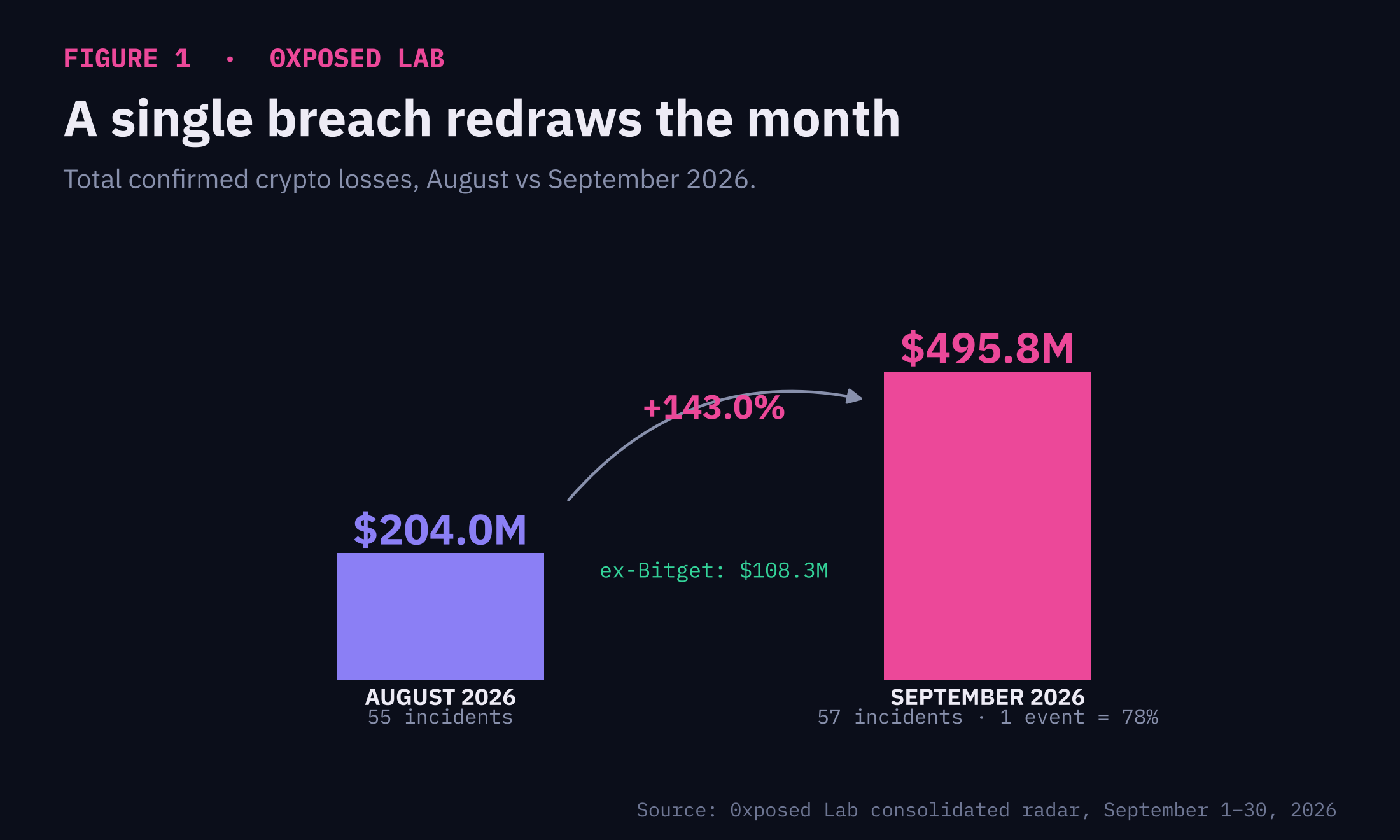
The scale is worth stating plainly: Bitget alone is larger than any complete month the radar has logged since April — 1.9x August's entire total, 2.0x July's, and 4.7x May's. Only April 2026, at $647M, was heavier than this September. Across the 51 incidents with a confirmed figure the mean was $9.7M and the median $238,000. Remove Bitget and the mean collapses to $2.2M. 51 of the 57 incidents carry a confirmed dollar figure; six are zero-loss or structurally unquantified.
Where the money went
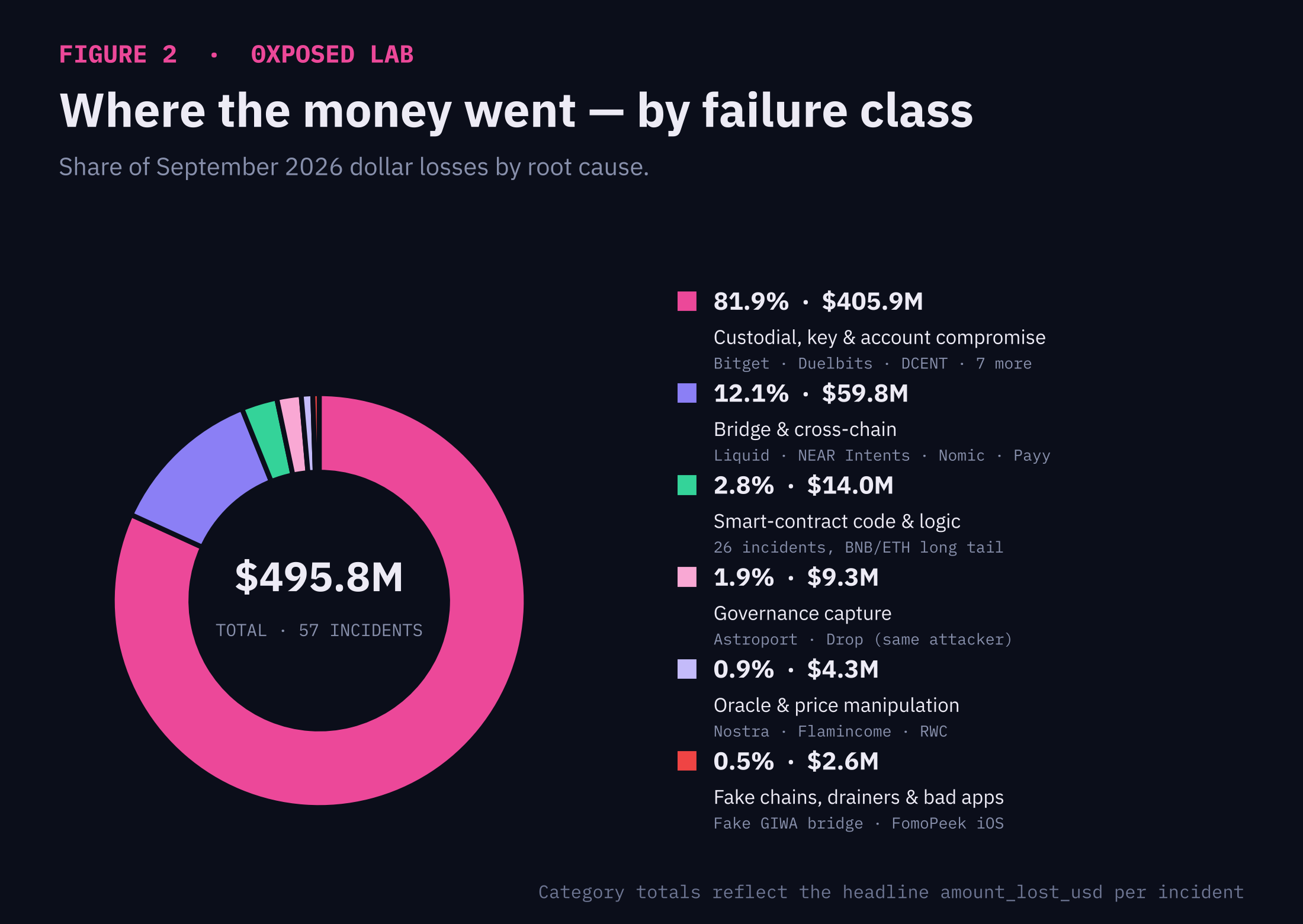
This is the chart that matters, and it is the most lopsided the series has produced. Custodial, key and account compromise accounted for 81.9% of losses ($405.9M) across just 10 incidents. Bridge and cross-chain failures took 12.1% ($59.8M) across 8. Classic smart-contract code and logic bugs — September's most common failure mode by a wide margin, with 26 of the 57 incidents — produced only 2.8% of the dollars ($14.0M). Oracle and price manipulation — seven separate incidents — accounted for 0.9%. The inversion is total. The thing that happens most often is now the thing that costs least, and the thing that costs most does not touch contract code at all.
Six things worth knowing
One breach is 78% of the month. Bitget's backend compromise drained $387.5M across eight chains simultaneously — Ethereum, XRP Ledger, Tron, Zcash, BNB Chain, Avalanche, Arbitrum and Base. Elliptic attributes it to North Korea-linked actors with high confidence.
The money left the chain. 10 custodial and key-compromise incidents produced 81.9% of losses; 26 smart-contract exploits produced 2.8%. Auditing the contract would not have prevented $405.9M of September's damage.
The operator became the recovery mechanism. Seven incidents ended with the platform covering losses from its own balance sheet rather than recovering anything from the attacker — Bitget's $464M User Protection Fund, MEXC, ether.fi, Chainflip, Dominion Market, Rocket's promised refund plan and DYORSWAP's 200+ ETH for the fake GIWA bridge.
The "white hat" frame got weaponized. Liquid's attacker returned 85% of a $320M drain, kept $47M as an unagreed bounty, then demanded a further 10% from Blockstream and threatened to publish the decryption key to the negotiation channel.
One attacker took two protocols in one window. Astroport ($4.9M) and Drop Protocol ($4.4M) fell to the same actor exploiting Neutron's governance mechanism between 02:25 and 07:44 UTC on September 22. They now share a 4-of-6 recovery multisig.
The largest victim count came from a chain that never existed. A counterfeit OP Stack L2 deployed on reserved Chain ID 9134 took 767.65 ETH from 1,335 addresses — no exploit, no vulnerability, just a listing on an aggregator and a plausible name.
The biggest incidents
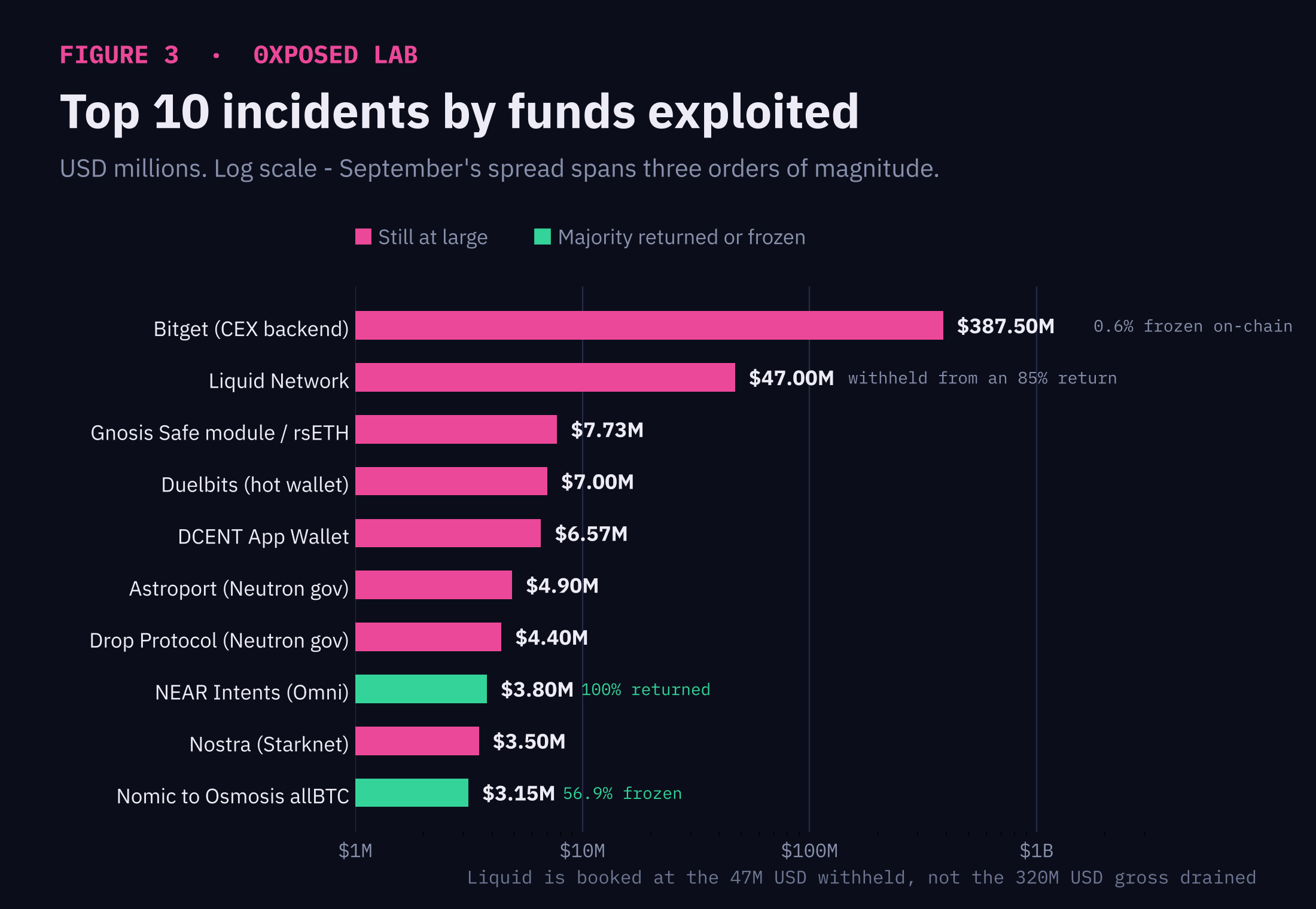
Bitget — $387.5M. At 18:31 UTC on September 24 the exchange's backend infrastructure was compromised, triggering unauthorized mass withdrawals across eight networks at once. Withdrawals were frozen shortly after detection; roughly $2.42M has been seized or frozen since, including 1,227,121 ATOM. Bitget committed a $464M+ User Protection Fund to cover users in full. Attributed to North Korea-linked actors by Elliptic, consistent with Lazarus Group tradecraft.
Liquid Network — $47M withheld. A range-proof cache-key collision in Elements let an attacker mint ~4,000 unbacked L-BTC and peg out through a whitelisted service; the federation's 11-of-15 multisig paid ~3,996 BTC (~$320M) 36 minutes later, every signing key working exactly as designed. The attacker returned 3,400 BTC and kept 598.5. Peg-outs were still suspended 11 days on. Documented by Bitquery and TRM Labs.
Gnosis Safe custom module / rsETH — $7.73M. A defective authorization check in one user's custom Safe module, abused through a router's multicall path. An unrelated MEV bot called "Yoink" front-ran the attacker in the same block, intercepting 2,882.37 rsETH before the original attacker could claim it — so the headline figure does not reflect what the attacker kept. Neither Safe's core code nor Kelp DAO's infrastructure was at fault.
Duelbits — $7M. The hot wallet was drained across Tron, BSC and Ethereum inside a four-minute window, consolidated into a single Ethereum wallet holding ~2,234 ETH.
DCENT App Wallet — $6.57M. Unauthorized transfers tied to the software App Wallet across Bitcoin, Ethereum, XRPL, TRON and EVM chains. IoTrust declined to publish the vector, arguing disclosure would enable copycats. The figure is a single-source estimate and has never been confirmed by DCENT.
Astroport — $4.9M · Drop Protocol — $4.4M. One attacker, one five-hour window, two Neutron protocols, $9.3M combined. A shared 4-of-6 recovery multisig was stood up with validator and ecosystem support.
NEAR Intents — $3.8M. A withdrawal-signing bug in the Omni infrastructure let an attacker pull 3,865,021 BSC-USD from the BNB Chain vault after two test withdrawals of 10 and 11 USDT. NEAR paused 11 networks, identified the exploiter, issued a 48-hour ultimatum and reported all funds returned. The return has not been independently verified.
Nostra — $3.5M. A fake NSTR/SolvBTC pool inflated collateral values on the Starknet lending market. The deployer wallet had been staged seven days earlier with CCTP bridging and AVNU-routed swaps in exactly the tokens later used to distort the oracle. The market remains frozen.
Nomic → Osmosis — $3.15M. A double-spend on Nomic's custom forwarding code sent falsified nBTC vouchers to Osmosis over IBC, hitting ~36% of Alloyed BTC's backing. Neither Osmosis nor IBC was compromised. An emergency validator upgrade froze 22.65 of the 39.84 BTC; the governance vote to seize them had still not been held 11 days later.
Twenty incidents dated to late August and two to early October are excluded from these totals — the August cohort was already counted in last month's report.
The geography of the losses
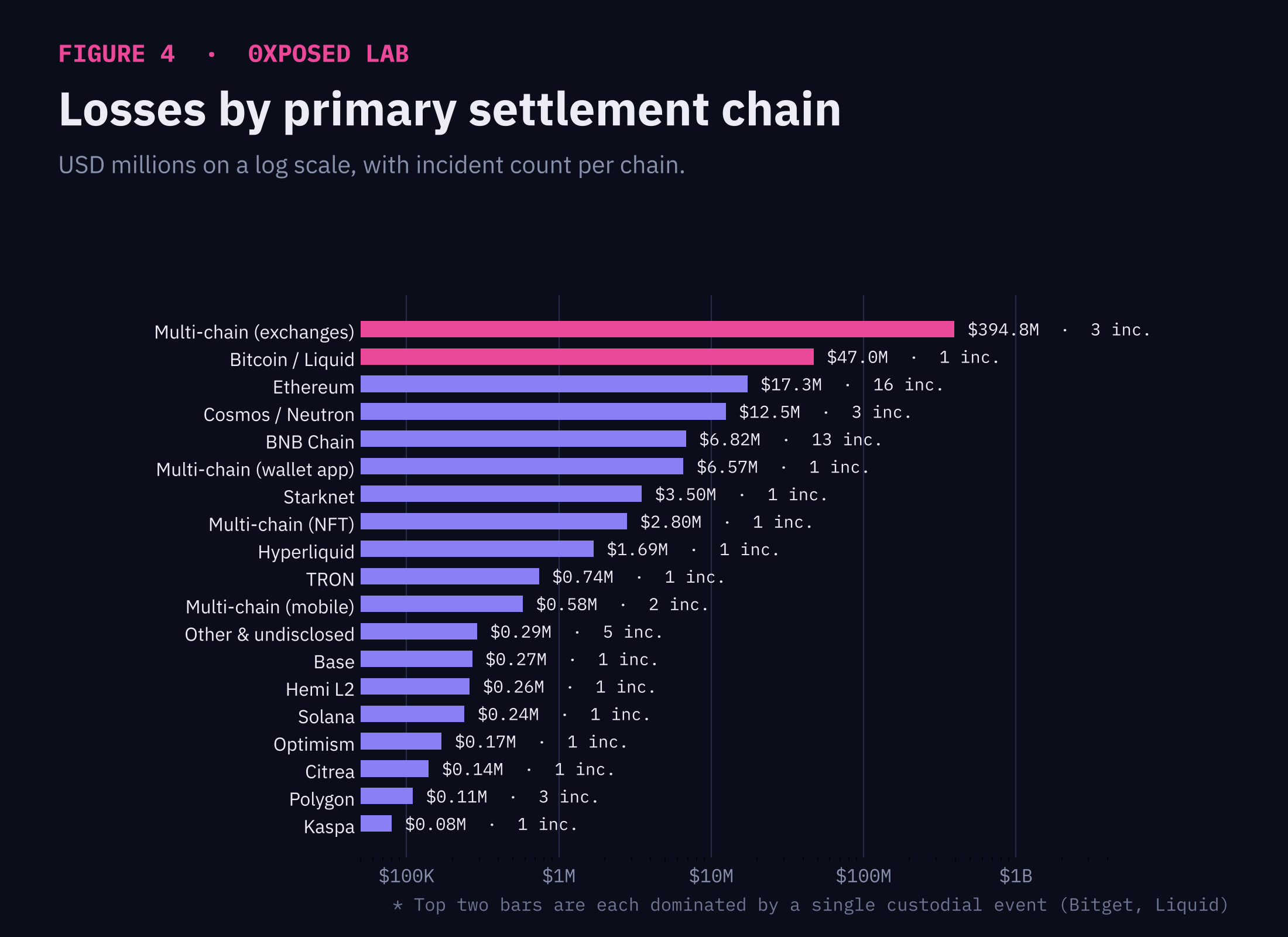
The chain table has stopped describing where the risk is. The top two bars — $394.8M across three exchange incidents and $47M on Bitcoin/Liquid — are custodial events that happen to settle on many chains at once, not properties of any chain's design. Underneath them the picture is conventional and small: Ethereum carried the most incidents by far (16) for only $17.3M — mostly logic bugs, flash-loan manipulations and access-control misses, plus the fake GIWA bridge and the MetaMask validator compromise. Cosmos and Neutron come next on dollars ($12.5M across 3), entirely because of the Astroport–Drop pair and the Nomic double-spend. BNB Chain produced 13 incidents for $6.8M, but $6.1M of that is NEAR Intents and Meter Passport alone — 11 of the 13 came in under $200K. Eleven further entries in the table carry a single incident each.
Three trends that define the month
The operator is the attack surface. Three of the four largest events were an exchange backend, a federation multisig and a set of hot wallets. In each case the cryptography held and the signing keys behaved correctly — the operator around them did not. There is no audit, formal verification or bug bounty that addresses this class, because the failure is organizational rather than computational.
Restitution has decoupled from recovery. September's users were made whole far more often than September's funds were returned. Bitget's $464M fund, MEXC's compensation, ether.fi's reimbursement, Chainflip's make-whole, Dominion's USDC refunds and DYORSWAP's 200+ ETH all came from the operator's own money. Returns from the attacker were rarer: NEAR Intents' reported full return and Liquid's 85%. The rest of September's recovery came from the chain or the platform intervening — Osmosis's validator-level freeze of 56.9%, Kasplex's 88.5% of escrow blocks and voluntary returns. What used to be an exceptional gesture is now the default response — and it quietly converts a security failure into a balance-sheet question, which only well-capitalized operators can answer.
Fake infrastructure outperformed real exploits. The counterfeit GIWA bridge, the FomoPeek iOS wallet-drainer and the GTA 6 leak campaign attacked no contract and exploited no bug. The GIWA case alone produced 1,335 identified victims — more than every other September incident combined. When a convincing name, a reserved chain ID and an aggregator listing are enough, the attacker never has to find a vulnerability at all.
"we are whitehats. contact us on chain" — the Liquid Network attacker, written into a Bitcoin OP_RETURN field hours after draining ~3,996 BTC. Blockstream replied with PGP-signed messages in the same channel. The attacker returned 85%, kept $47M as an unagreed bounty, then demanded a further 10% and threatened to publish the channel's decryption key.
Who caught it — and who got their money back
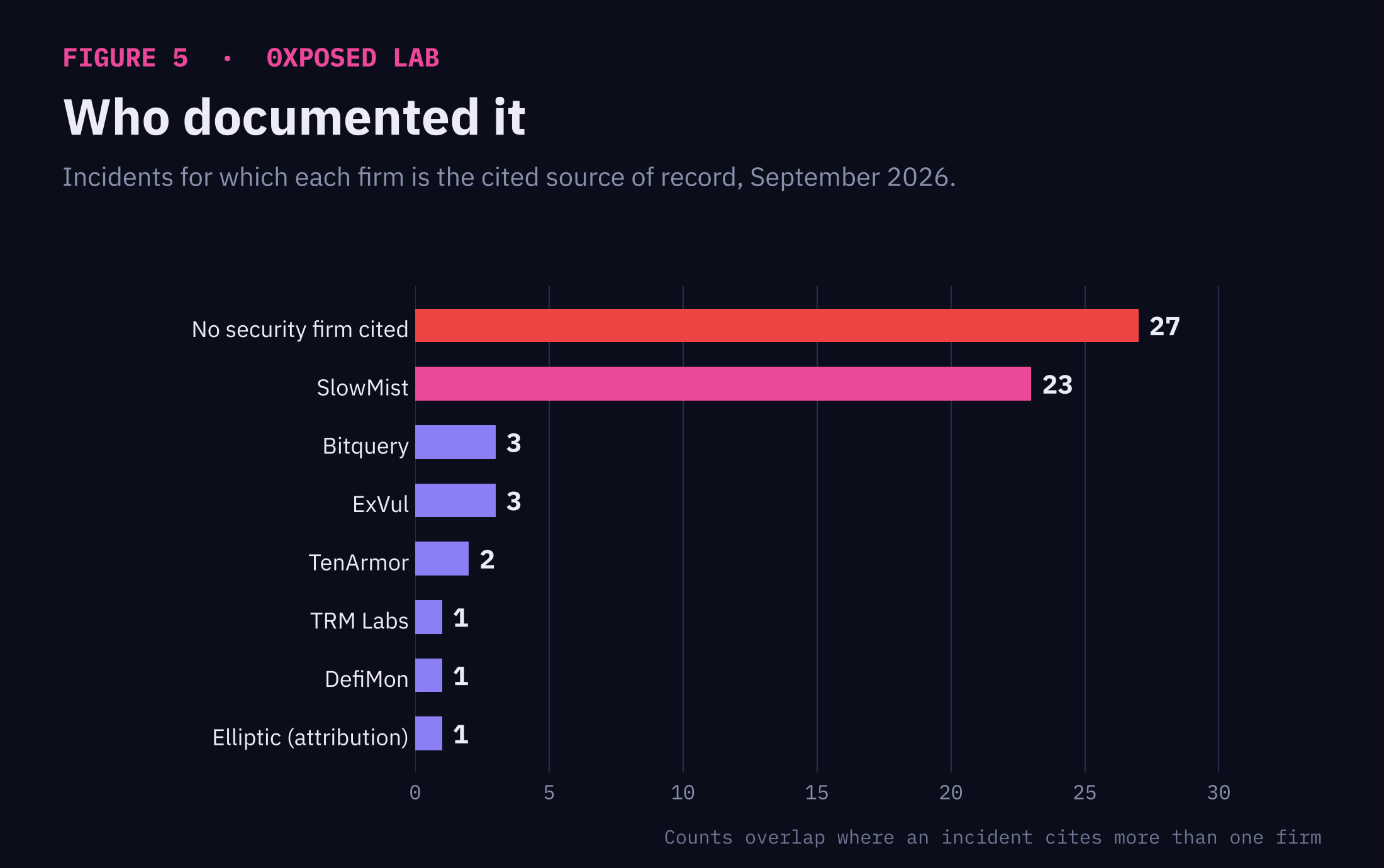
The documentation layer is strikingly concentrated. SlowMist is the cited source of record for 23 of 57 incidents — 40% of the month — with Bitquery and ExVul on three each, TenArmor on two, and TRM Labs and DefiMon on one apiece. Elliptic appears once, for the Bitget attribution rather than as a source of record. For 27 incidents no security firm is cited at all; those entries rest on block explorers, project statements, independent on-chain tracing and proof-of-concept repositories such as DeFiHackLabs. A single firm's publication schedule now shapes what the public record of crypto theft looks like, which is precisely the concentration risk a victim-facing radar exists to document.
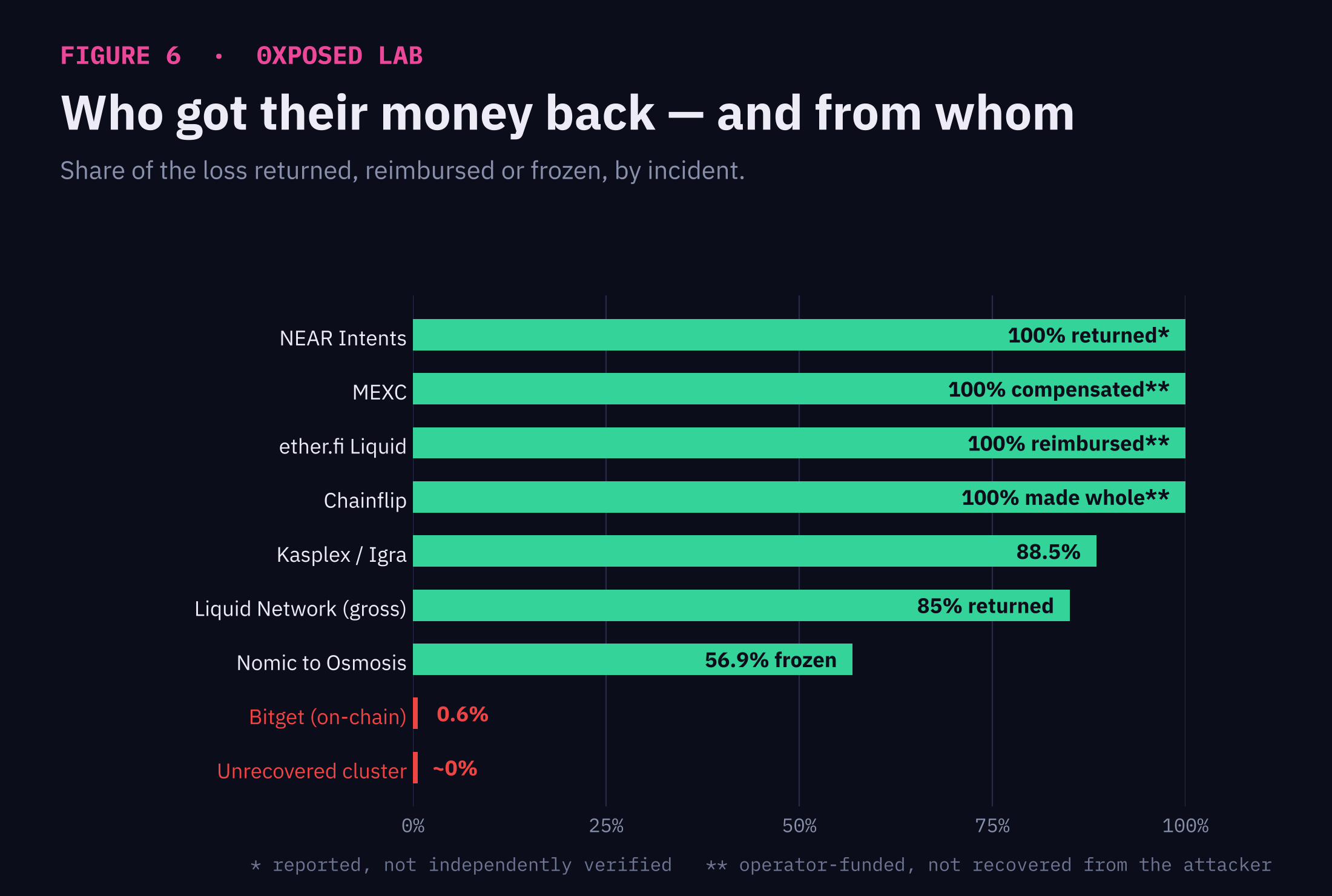
Recovery and restitution diverged sharply. Four incidents reached 100% — NEAR Intents (reported), MEXC, ether.fi Liquid and Chainflip — but only one of those came from the attacker. Kasplex recovered 88.5% through escrow blocks and voluntary returns; Liquid got 85% of its gross back; Osmosis froze 56.9% on-chain. At the top of the table the picture reverses: Bitget has frozen 0.6% of $387.5M, and seven of the nine others show no recovered balance against the booked figure. The Notional attacker's proceeds were converted to ~689.2 ETH and laundered through Tornado Cash; the fake GIWA bridge's 764.9 ETH followed over 27 hours in 80 deposits.
What to do about it
If you run a custodial platform: your threat model is your own infrastructure, not the chain. Bitget and Duelbits both began inside the perimeter, and Duelbits lost $7M across three chains in four minutes. Withdrawal rate limits, per-chain circuit breakers and out-of-band approval for bulk outflows do more here than any contract audit.
If you operate a federation or threshold multisig: Liquid's 11-of-15 signers all behaved correctly and still authorized a $320M payout, because the bug was upstream in the proof system. Validate what you are signing, not just that enough parties signed it.
If you run on-chain governance: one actor took two Neutron protocols in five hours. Model the cost of acquiring decisive voting power against the value your treasury holds, and put a timelock between a passed proposal and its execution.
If you depend on an upstream chain or bridge: Osmosis was not compromised and still lost 36% of Alloyed BTC's backing to Nomic's forwarding code. Inventory what your assets' backing actually depends on, and define in advance who absorbs the shortfall.
If you plan to reimburse users: write the policy and fund it before you need it. Seven protocols executed this in September; the ones that moved fastest already knew where the money would come from.
If you're a user: verify a network before you bridge to it — chain ID, official announcement, the project's own site — and treat an aggregator listing as no evidence at all. 1,335 people bridged into a chain whose team was publicly saying it had not launched.
A few caveats
51 of 57 incidents carry a confirmed USD figure. Six contribute $0 to the totals but are counted in the incident number and the vector breakdown: the GTA 6 drainer campaign, the "Bold" wallet compromise, MultiversX's blocked VM exploit attempt, Blink Wallet, the Nano Labs X account hijack and Zano's gateway flaw (resolved by chain rollback).
Liquid Network is booked at the $47M withheld, not the $320M gross drained, because 85% was returned the following day. Figure 6 shows the gross recovery rate for comparability.
DCENT's $6.57M rests on a single source and has not been confirmed by the company; the vector remains formally undisclosed.
Twenty incidents dated between August 22 and 31 are excluded as out-of-window and were counted in the August report. FlashLoopAdapter and the Microsoft X account hijack (both October 1) are deferred to next month.
NEAR Intents' reported full return of 34.589 BTC has not been independently verified. MUSystem is charted at SlowMist's $36,900 gross figure; the attacker's net gain after the flash-loan injection was roughly 3.19 ETH (~$8,600).
NEAR Intents is dated September 30, when the two test withdrawals were made, and is counted in September on that basis. The $3.8M itself left the vault between 23:54 UTC on September 30 and 06:08 UTC on October 1, and the pause, the ultimatum and the reported return all fell on October 1–2.
Figure 2's six failure classes are each rounded independently, so the legend adds up to $495.9M and 100.1%. The unrounded components sum exactly to $495,818,289.
Bitget is the only September incident carrying a nation-state attribution at the time of writing.
All on-chain claims are independently verifiable on the respective block explorers. This report is informational and not financial, legal, or security advice. 0xposed Lab — Track. Document. Fight Back.