

October 2026: $6.51B Lost — and One Exchange Was 97.6% of It
12 views
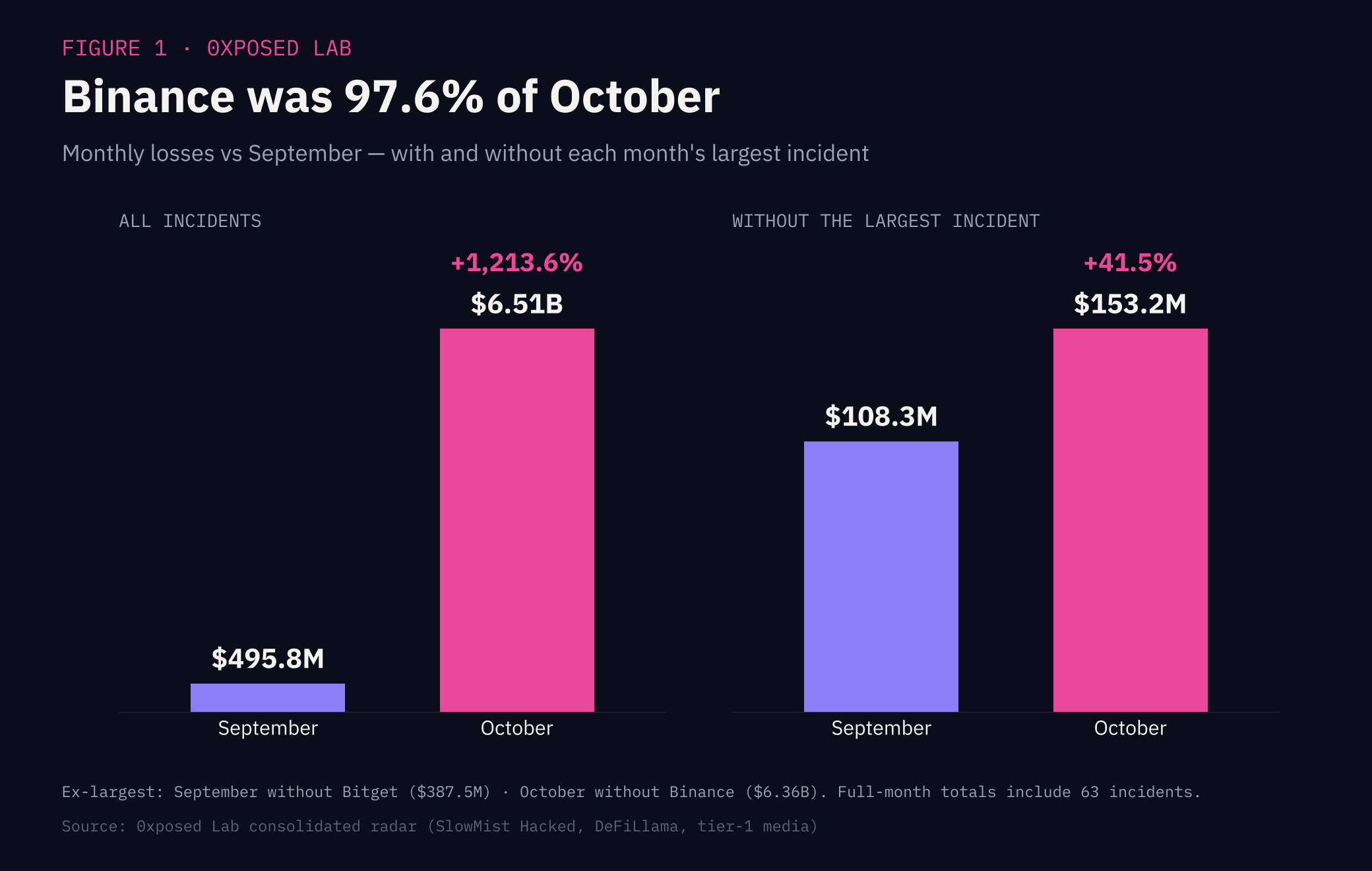
October 2026 booked $6,513,229,704 in losses across 63 incidents, roughly ten times April 2026's $647M, the previous high in our series. One of them, the drain of Binance's hot wallets on October 29, accounts for $6.36B of it. Take it out and what remains is $153.2M: a bad month, 41.5% above September on the same basis, and a different story. The big number appears to point to the signing path of a single custodian. The small number says the industry's real exposure sits in the vendors, scripts and keys around the contracts.
The headline — and why it's misleading
The headline is $6.51B, 13.1 times September's $495.8M. It is also the least informative figure in this report. Binance alone is 97.6% of the total. A fair comparison removes each month's largest incident: September without Bitget was $108.3M, October without Binance was $153.2M, an increase of 41.5%.
The distribution is just as skewed. Across the 51 incidents with a confirmed figure, the mean was $127.7M and the median $727,000. Without Binance the mean falls to $3.1M and the median to $632,500. Of the 51 confirmed figures, 31 came in under $1M, and together they account for $8.3M, or 0.13% of the month.
Where the money actually went
Custody and key compromise produced $6.39B, or 98.1%, across only six incidents. That is the Binance effect. Remove it and the picture inverts: supply-chain and third-party failures become the largest class at $95.0M, or 62.0% of the remaining $153.2M, led by the Ledger and CryptoBilis hardware-wallet compromise at $87.0M, whose supply-chain cause is suspected rather than confirmed. Code and protocol flaws are the most numerous class (22 incidents) and the third largest in dollars at $17.7M.
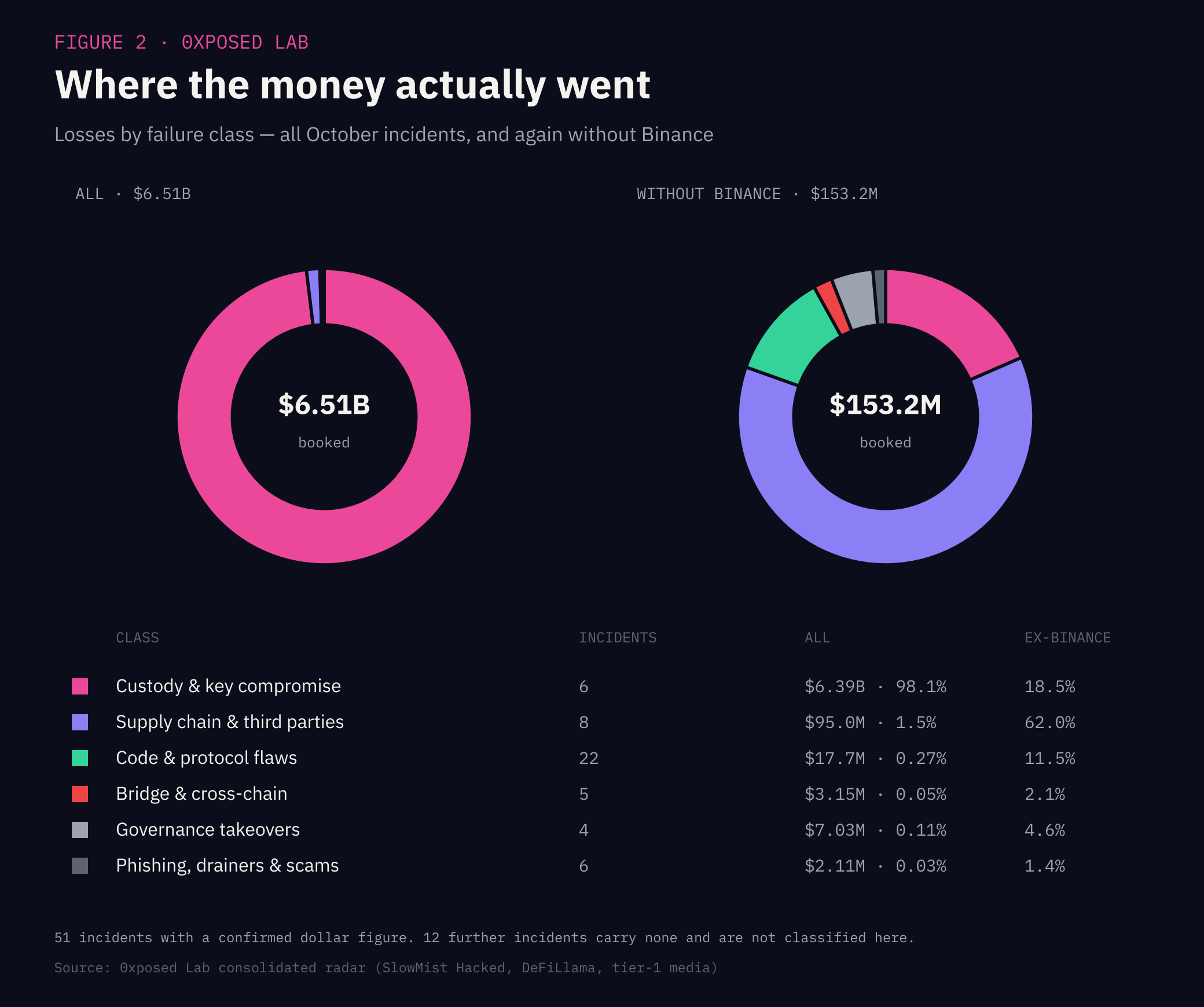
The classification is ours and is judgment-based: it follows the root cause stated in each incident record, and ambiguous cases are listed in the caveats.
Six things worth knowing
One incident was 97.6% of the month. Binance's $6.36B hot-wallet drain was attributed to North Korea's TraderTraitor cluster by TRM Labs (high confidence) and Chainalysis ("likely") on October 30, and the FBI named North Korea on October 31.
Without it, the month was $153.2M. That is 41.5% above September's $108.3M once Bitget is removed.
The second-largest event was not a protocol. Ledger devices bought through the reseller CryptoBilis were drained for $87.0M across 98 addresses, 56.8% of everything outside Binance. The cause is suspected, not confirmed.
Twelve of the 63 incidents carry no confirmed dollar figure. They are data breaches, account takeovers, a rolled-back chain and campaigns without a quantified loss. They count in the incident total and not in the dollars.
Recovery is mostly about who pays, not who returns. Attackers and whitehats gave back roughly $18.2M. About $2.7B of Binance's loss was frozen on-chain by stablecoin issuers and others. Platforms reimbursed users at Polymarket, Bloom, Predict.fun and Myriad Markets.
The long tail is small and busy. Fifteen incidents were under $100,000, and the 25 dated October 22–28 made the busiest week of the month by count, though not by dollars.
The biggest incidents
The top ten range from $6.36B down to $2.7M, which is why the chart uses a logarithmic scale. Of the 10, 5 are custody or key events, 2 are supply-chain events, 2 are code or protocol flaws and 1 is a governance takeover. Two ended with most of the money back.
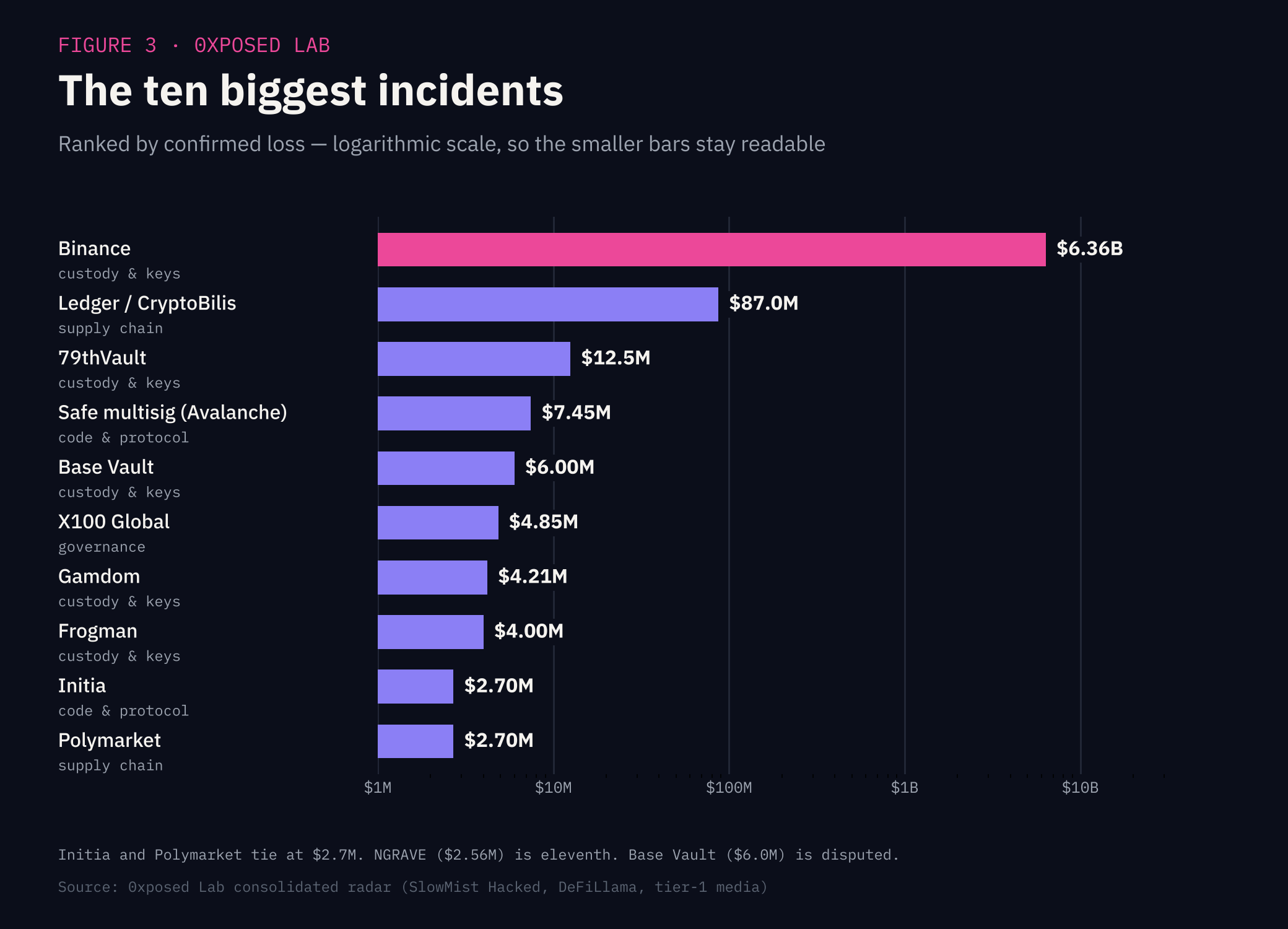
Binance — $6.36B. Between 20:05 and 20:24 UTC on October 29, funds left Binance hot wallets on 10 chains. On Ethereum, a single type-4 transaction carried 50 pre-signed EIP-7702 authorizations, one of which matched the signing wallet's current nonce and delegated control to a sweeper contract. A sweep of 167,464 ETH and 63 tokens followed three minutes and 24 seconds later. Tether froze 971.1M USDT and Circle 823M USDC within an hour. Binance says it reserved more than $6.34B to cover users. Its technical post-mortem had not been published as of November 3.
Ledger / CryptoBilis — $87.0M. Arkham tallied $86,964,156 across 98 addresses on BTC, ETH and TRON. More than $10M was frozen with Tether, SEAL 911 and law enforcement. Specter published the first theft addresses.
79thVault — $12.5M. An operator key called a backdoor function on the token contract and extracted roughly 16,249 BNB. The attacker returned 15,000 BNB on October 9 and kept about 1,249 BNB as a bounty.
Safe multisig on Avalanche — $7.45M. A 2-of-7 Safe had signed unlimited token approvals on March 7 to an address with no code. On October 26 an attacker deployed a contract at exactly that address by burning nonces. An MEV bot front-ran the transaction and returned the funds, keeping a $371K bounty. Defimon alerted at 13:00 UTC.
Base Vault — $6.0M. A 3-of-7 Safe whitelisted the borrower about a minute before the drain. Whether this was a legitimate owner action or a signer compromise is disputed, and about $31.7M remains in the vault. PeckShield flagged it as suspicious.
X100 Global — $4.85M. A flash loan of about $1.94M bought two thirds of the Senate seats in a system with no snapshots and no execution delay.
Gamdom — $4.2M. The casino's hot wallets were drained across several chains on October 13. SlowMist lists $4,208,000; the founder described the loss as just over $3M, and the gap is unexplained.
Frogman — $4.0M. Two personal wallets were drained across Solana, BSC and Base within about two minutes on October 6. No funds were recovered.
Initia and Polymarket — $2.7M each. Initia's MoveVM minted unbacked tokens that were bridged out before the chain was halted. Polymarket lost $2.7M across 726 wallets after a monitoring script served from a vendor CDN intercepted signatures.
The 27 incidents dated to September and 17 dated to the first week of November are excluded from these totals. The September incidents were already counted in last month's report.
The geography of the losses
Multi-chain incidents, those with funds drained on three or more chains or a custodian spanning several, took $6.46B, or 99.2% of the month, across just 8 incidents. Among single chains the picture is flat. BNB Chain led on dollars with $14.6M across 7 incidents, followed by Ethereum with $10.3M and Avalanche with $8.5M.
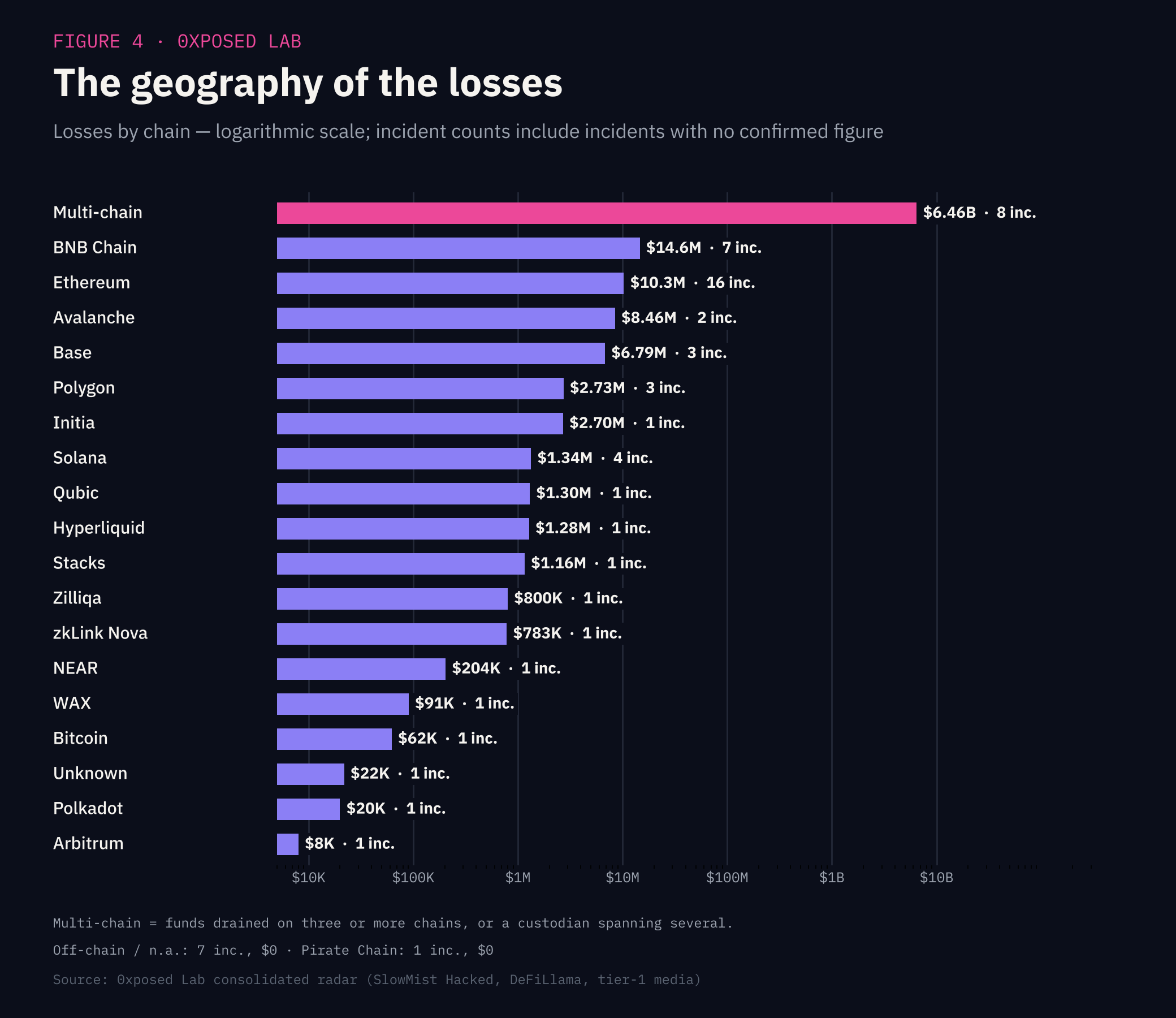
Ethereum carried the most incidents by far (16) for $10.3M, mostly small contract exploits and phishing. Avalanche had just 2 incidents for $8.5M, the Safe multisig and TranchePool. Base recorded 3 incidents for $6.8M. Seven incidents had no chain at all, because they were data breaches, account takeovers or a phishing campaign.
Three trends that define the month
The signing path is the target. In all, 6 custody and key incidents produced $6.39B, 98.1% of the month. Binance, 79thVault, Gamdom, Frogman, a private-key drain of nine wallets traced by ScamSniffer ($1.58M) and Base Vault all point to failures of keys or signing authority rather than of contract logic, though Frogman's key compromise is suspected, Base Vault is disputed and Binance's exact mechanism is unconfirmed. Binance's own account of the breach is still evolving. Its first hypothesis was a compromised DevOps laptop; later the same day its CEO said:
"Not a single one-click action, more complex attack process." — Richard Teng, Binance, October 30, after the exchange reported "additional points of breach"
The vendor layer is now a primary vector. In all, 12 incidents began at, or are attributed to, a third party: Ledger's reseller (suspected), NGRAVE's push-notification provider, Railway's cloud secrets, Polymarket's monitoring CDN, Bloom's third-party module, Predict.fun's documentation site, the Lottie Player npm package, the Fearless Wallet extension, Solflare's staking provider, Coinbase's analytics vendor Amplitude, Keystone's monitoring tool and Myriad's backend library. The 8 with a confirmed figure account for $95.0M.
Governance is being bought, not hacked. X100, Hifi Finance, Arkadiko with StackSwap, and Yapeswap lost $7.0M combined. The mechanisms were a flash loan with no snapshot, last-minute votes funded through Tornado Cash on a proposal submitted six days earlier, a single wallet accumulating voting power, and a quorum set to zero. Arkadiko's bounty program lists basic governance attacks as out of scope.
Who caught it — and who got their money back
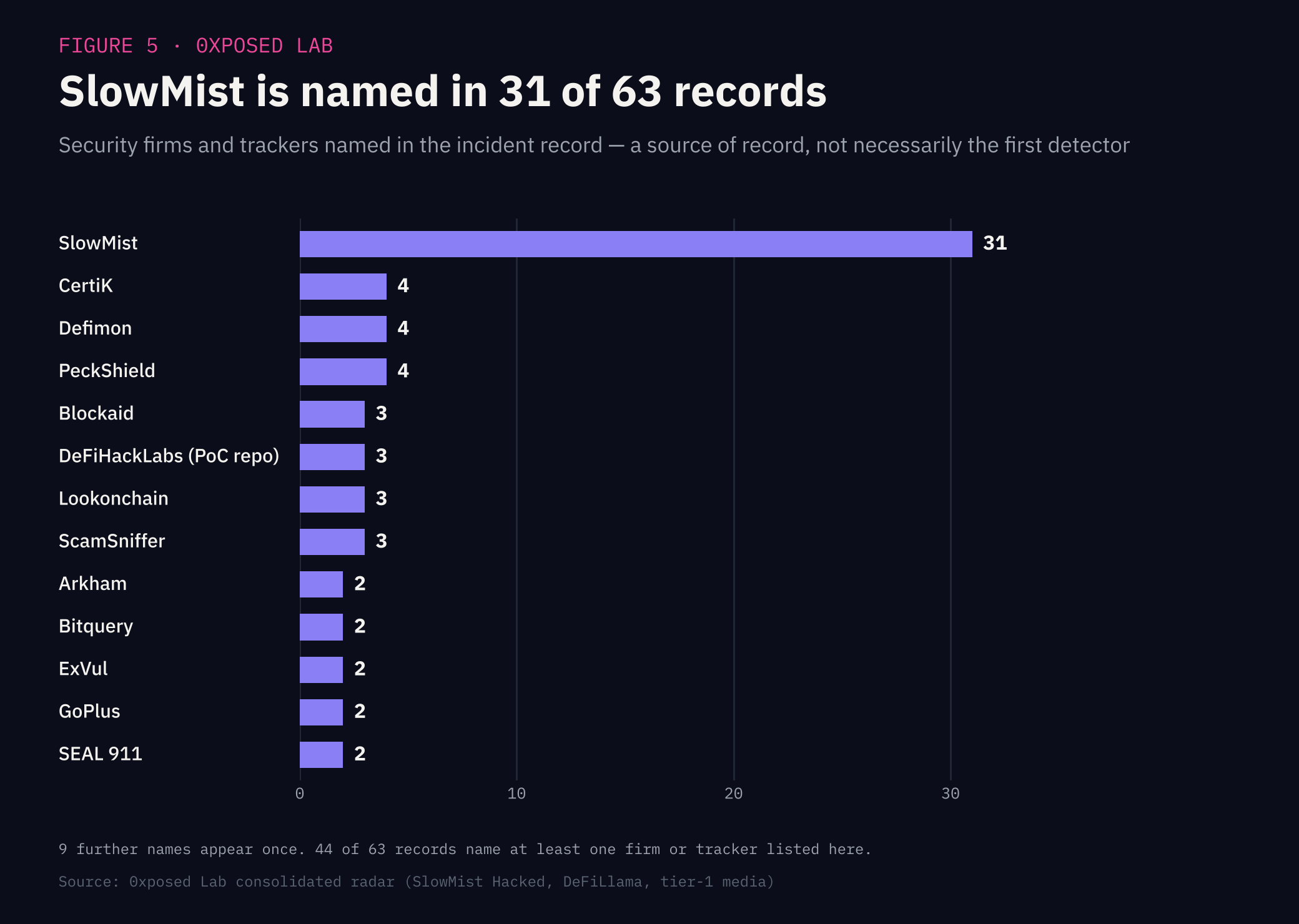
SlowMist is named in 31 of the 63 incident records, almost half. No other firm appears in more than 4: CertiK, Defimon and PeckShield sit at four each. In all, 44 records name at least one of the firms and trackers we follow, which leaves 19 resting only on project statements, block explorers and media. This measures the cited source of record, not who was first to see the transaction.
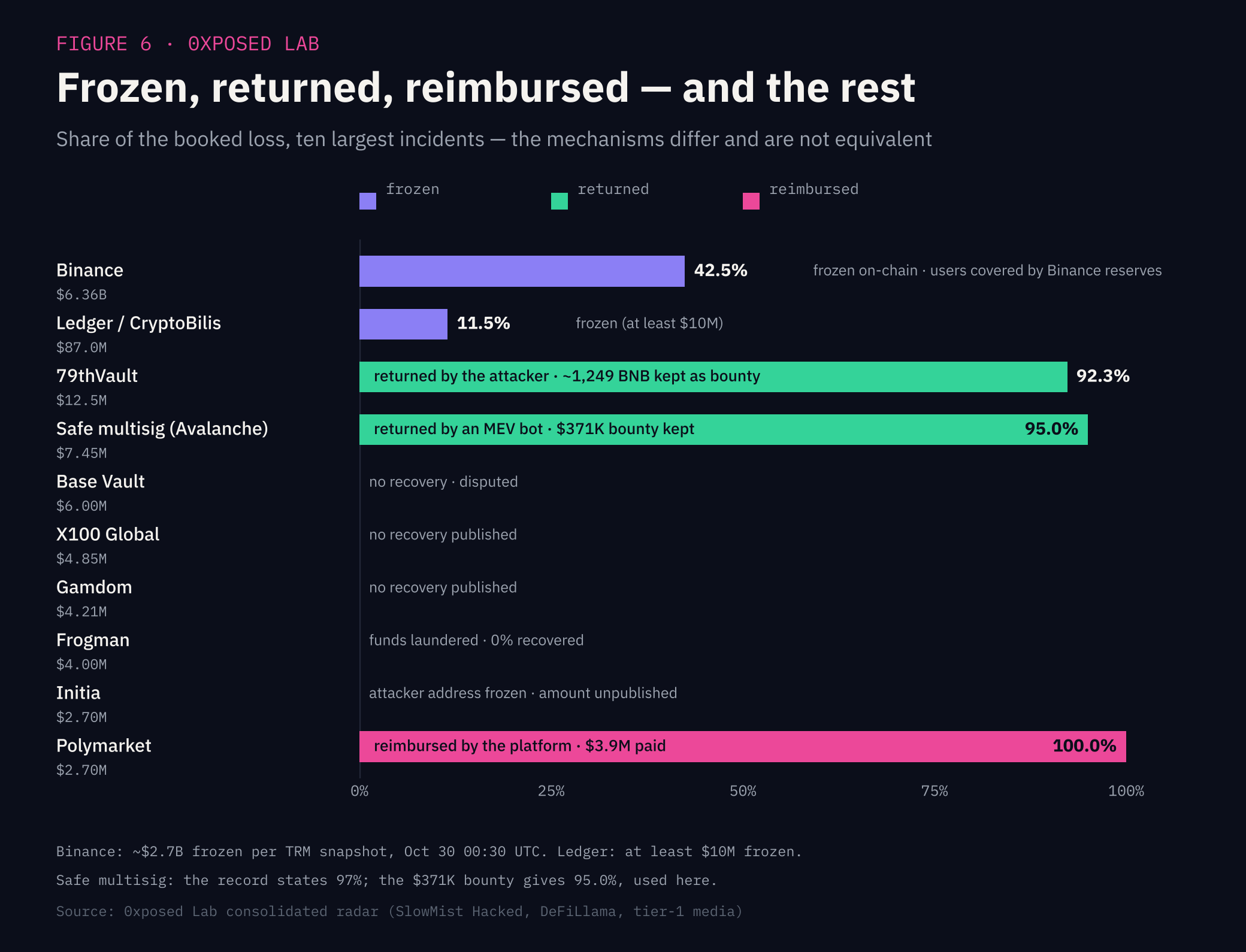
Recovery split into four different things. Binance had about $2.7B frozen on-chain, 42.5% of its loss, and says users are covered from reserves. 79thVault recovered 92.3% from the attacker and the Safe multisig about 95.0% from an MEV bot. Polymarket reimbursed $3.9M against $2.7M stolen. Of the top 10, 5 show no recovered balance, though Agora froze the attacker's address in Initia's case without publishing an amount.
What to do about it
If you run an exchange or custody stack: treat the signing system as the asset. Segregate hot-wallet signing from developer machines, limit how many pre-signed authorizations can exist at once, and alert on type-4 transactions touching treasury addresses.
If you operate a protocol: inventory every third-party script on your front end and every analytics, docs and monitoring vendor with access to keys. Pin dependencies, use subresource integrity and rotate API keys on a schedule.
If you run a DAO: require voting snapshots, a holding period and an execution delay. Set a non-zero quorum and put governance in scope of your bounty program.
If you use a hardware wallet: buy only from the manufacturer, and never type a recovery phrase into a website. A fake firmware-update campaign followed the CryptoBilis news within a week.
If you're a user: revoke old approvals, never authorize an EIP-7702 delegation you did not initiate and check the full address before sending. Address poisoning cost two victims $355,619 this month.
If you suspect you're affected: move funds to a fresh wallet generated on a clean device first, then investigate.
A few caveats
The Binance figure of $6.36B is the amount booked in the incident record; Binance's own statement cited $6.3B and Chainalysis about $6.4B. Its post-mortem was unpublished as of November 3, so the mechanism and the amount may change.
Ledger / CryptoBilis is booked at the Arkham tally of $86,964,156; sources range from about $86M to $93M. The reseller-level cause is suspected, not confirmed, and the case is still developing. Base Vault ($6.0M) is disputed and may have been a legitimate owner action.
Booking rule: incidents are booked at the gross amount taken. The Safe multisig on Avalanche ($7.45M) and 79thVault ($12.5M) are therefore booked in full although most of the funds came back; the Safe record states 97% recovered, while the $371K bounty gives the 95.0% charted. Myriad Markets is $0 because no funds left the pools, and Pirate Chain is $0 because the chain was rolled back (its notional $10.7M mint is not counted).
Kimchi's $385,000 is the operators' reported profit, not a verified total of victim losses. The Zilliqa figure of $800,000 rests on a single estimator, and Hifi's $1M is approximate user collateral that excludes the 25M HIFI minted. Railway's $371,000 is a researcher's estimate not confirmed by the company.
FOMO phishing (more than $160,000) is reported only as a lower bound and carries no figure in the totals. Diamante's unofficial estimate is not used, and Initia's $4.54M of remaining on-chain value is not a realized loss. Gamdom's $4.2M is SlowMist's figure; the founder said just over $3M.
Failure classes and chain buckets are our judgment from the stated root cause, not provider labels. The Safe multisig is filed under code and protocol flaws although the trigger was an old signed approval. Only the 51 incidents with a confirmed figure appear in the dollar charts.
Incidents are placed by display date. Lottie Player (October 30–31) is included; 17 incidents dated November 1–6 and 27 dated September are not. One duplicate file was ignored.
The detection chart counts the firms named in each record. It shows the cited source of record, not who saw the first transaction.
All on-chain claims are independently verifiable on the respective block explorers. This report is informational and not financial, legal, or security advice.
0xposed Lab — Track. Document. Fight Back.