

May 2026: When the Bug Stopped Being in the Code
- Crypto Security
- Threat Intelligence
- DeFi
- Bridge Exploits
- On-Chain Forensics
- Monthly Report
24 views
May 2026 reads, on paper, as the calmest month for crypto theft in over a year. That reading is wrong. The total fell because the era of nine-figure smart-contract exploits paused — not because crypto got safer. What replaced it is harder to audit and harder to insure: the systematic compromise of the keys, signers, and cross-chain trust layers that sit above the code.
The headline — and why it's misleading
Crypto lost roughly $82 million across at least 40 separate incidents in May, an 87.4% drop from April's record $647M. The mean incident was ~$2.0M; the median just ~$200K — a distribution skewed by a handful of governance and bridge failures.
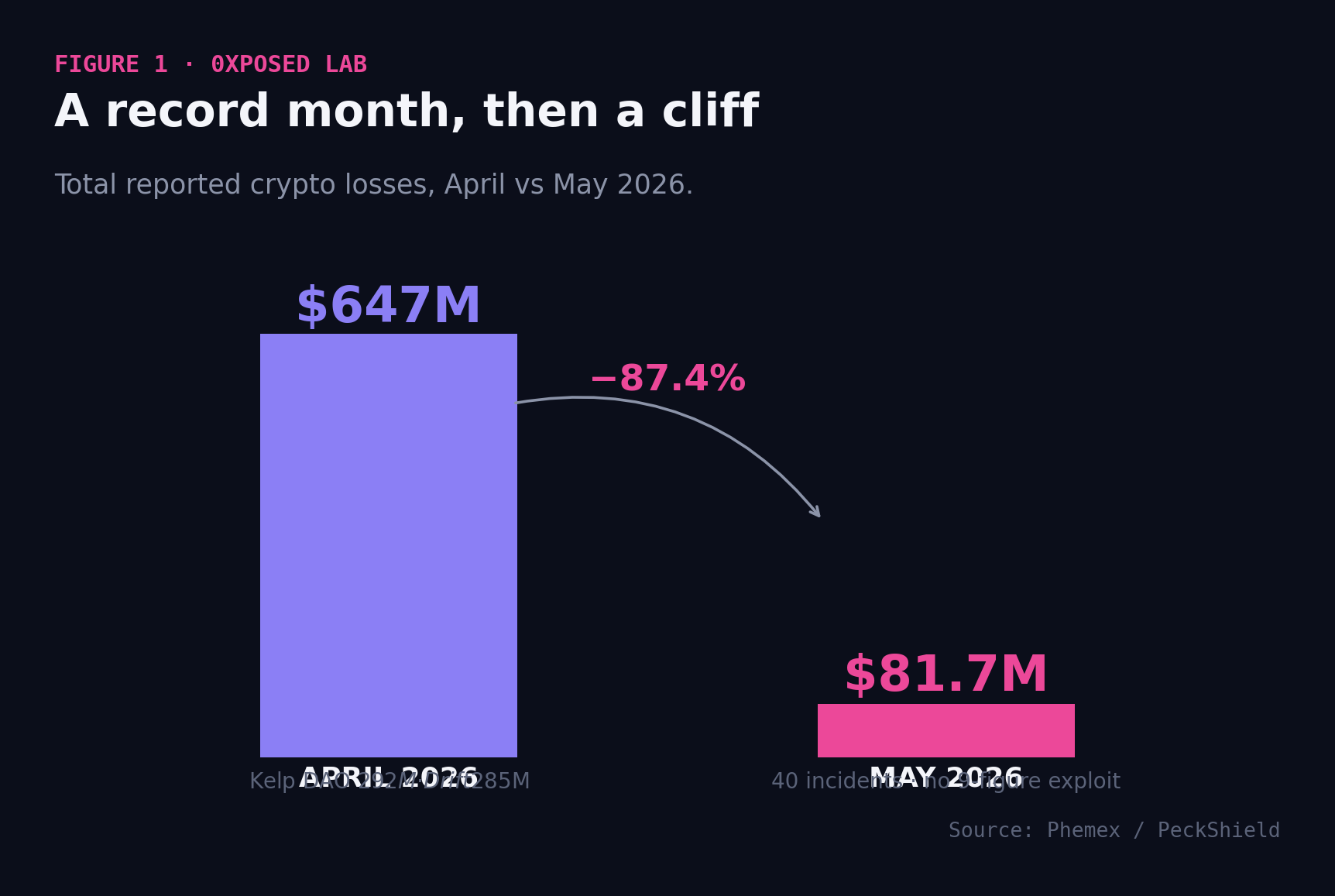
April's total was inflated by two DPRK-linked nine-figure incidents (Kelp DAO, Drift). Strip those out and May looks less like a recovery and more like a change of method. The attackers didn't leave. They stopped breaking the code and started stealing the keys.
Where the money actually went
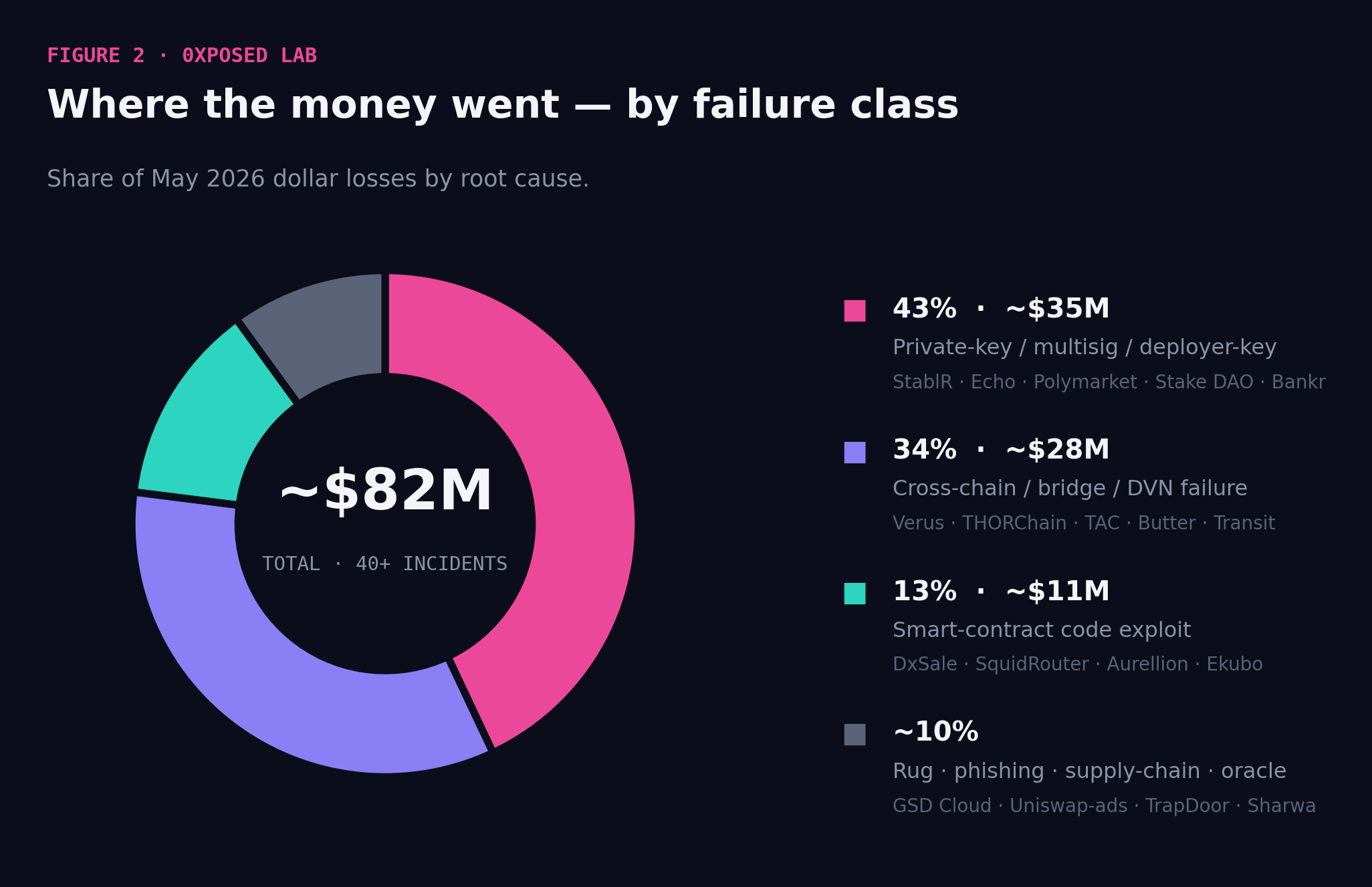
This is the chart that matters. Private-key, multisig and deployer-key compromises accounted for 43% of losses. Cross-chain, bridge and DVN failures for 34%. Classic smart-contract code bugs — the thing audits are built to catch — for only 13%. The dominant failure mode is no longer the contract. It's operational security and the trust assumptions between chains.
Six things worth knowing
Loss volume normalized; incident count stayed high. $82M is low by 2026 standards, but 40+ incidents in a month is not a quiet market.
Operational security dominated the dollars. Stolen keys and misconfigured multisigs (~$35M) plus broken bridges (~$28M) made up ~77% of all losses.
BSC led incident count; Ethereum led dollar losses. BSC produced a long tail of small exploits; Ethereum absorbed the large ones.
EIP-7702 abuse arrived in production. SQ Protocol on BSC is, to our knowledge, the first publicly documented live exploit using EIP-7702 account-delegation transactions.
An old one-line bug keeps drilling holes. Two BSC tokens (MoneyMon, ONTR) fell within 24 hours to the classic "ecrecover returns the zero address" signature-check miss.
Nation-state activity was indirect but present. No May incident drew high-confidence DPRK attribution, but Lazarus spent the month laundering April's $292M Kelp DAO proceeds through THORChain into Bitcoin.
The biggest incidents
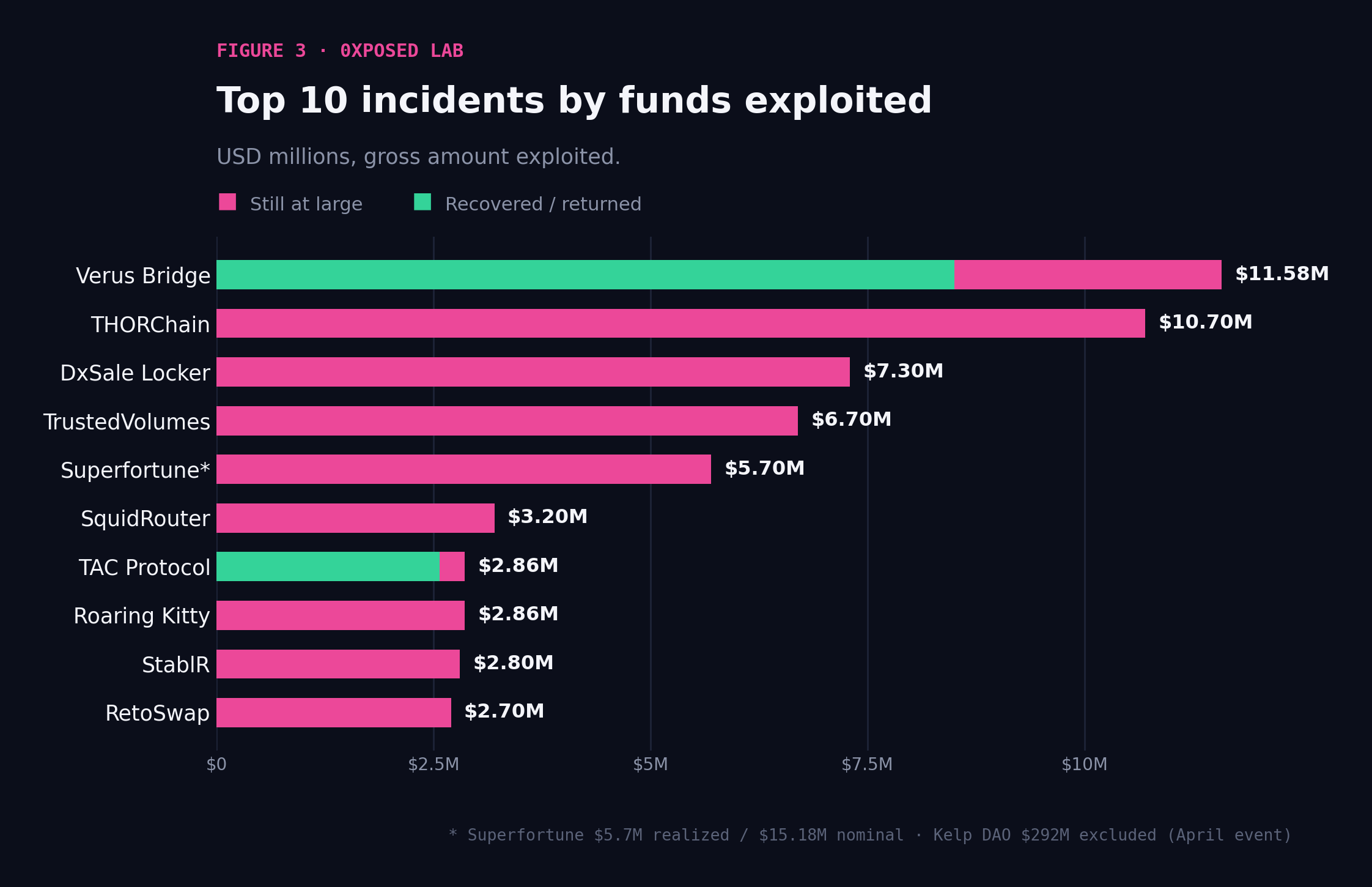
Verus–Ethereum Bridge — $11.58M. Missing source-amount validation let an attacker forge a cross-chain import worth millions for an input worth pennies. ~$8.5M was later returned; the rest kept as a bounty. Detected by Blockaid.
THORChain — $10.7M. A node that joined two days earlier reconstructed a vault key by exploiting the protocol's GG20 threshold-signature scheme — a known weakness class it was years behind on patching. Flagged by ZachXBT and PeckShield.
DxSale — $7.3M. ~1,400 dormant liquidity locks from the 2021 launch boom were drained via a privileged-fee mechanism and a backdated lock timestamp. Researchers suspect insider involvement.
TrustedVolumes — $6.7M. An independent market maker running as a 1inch Fusion resolver was drained through a custom swap-proxy flaw. The same actor hit 1inch resolvers in 2025.
Superfortune ($GUA) — $5.7M. An airdrop multisig payout was redirected to a look-alike address. Halborn ruled out the "address poisoning" the team first blamed. $15.18M minted, $5.7M realized.
SquidRouterModule — $3.2M. A malicious third-party Safe module accepted a publicly known string as authorization and drained 86 trusting wallets. Neither Squid nor Safe built it.
StablR (USDR/EURR) — $2.8M. A compromised key in a 1-of-3 minting multisig let the attacker remove both legitimate owners and mint millions of unbacked stablecoins. EURR briefly depegged to $0.85.
Two of the top ten — Verus and TAC Protocol — returned most of the funds through white-hat negotiation. Kelp DAO's $292M is excluded from May's numbers; its on-chain event was 18 April.
The geography of the losses
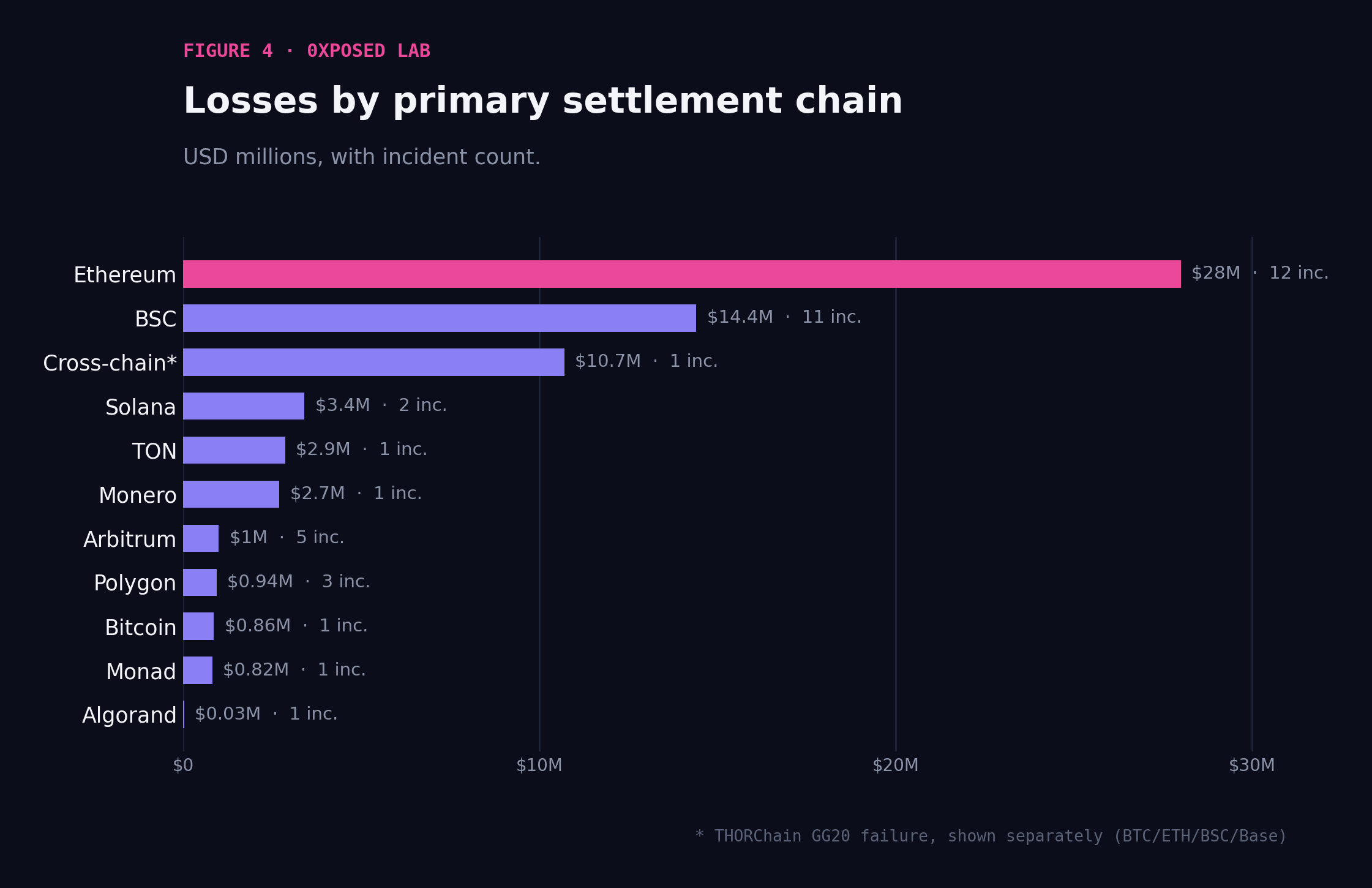
The chains tell two different stories depending on whether you count dollars or incidents. Ethereum absorbed the most value — roughly $28M across about 12 incidents — because the large, high-value targets land where the liquidity sits. BSC produced the most incidents (around 11), but almost all were small smart-contract exploits: a long tail of MoneyMon-, ONTR-, SKP- and Joe Agent-scale losses that rarely clear $100K. Arbitrum is the mirror image of Ethereum — five separate incidents (Stake DAO, Aurellion, ShapeShift, Renegade.fi, Sharwa) for barely $1M combined. And THORChain's $10.7M is shown on its own, because that single exploit spanned Bitcoin, Ethereum, BSC and Base at once. Multi-chain incidents are counted under their primary settlement chain, so the bars sum to the attributable subset rather than the full monthly total.
Three trends that define the month
Bridges and cross-chain messaging are still the biggest target. PeckShield counted eight major bridge exploits draining a cumulative $328.6M across 2026 through mid-May. May's Stake DAO incident weaponized the same LayerZero configuration surface as April's Kelp DAO hack. Solv Protocol and Kelp DAO both announced migrations to Chainlink CCIP, moving $700M+ in tokenized BTC off LayerZero.
AI agents and the software supply chain are the fastest-rising vector. The TrapDoor campaign planted 34 malicious packages across npm, PyPI and Crates.io — and hid instructions inside .cursorrules and
CLAUDE.mdfiles to turn AI coding assistants into credential thieves. The Bankr AI-wallet breach ($440K) and a Grok prompt-injection incident showed attackers exploiting the trust layer between automated agents, not the contracts beneath them.EIP-7702 made its forensic debut. SQ Protocol on BSC used the new account-delegation transaction type to seize ownership of a staking contract. Every protocol that gates ownership on a single externally-owned account is now inside this attack surface.
"I now consider all of DeFi unsafe." — Manuel Aráoz, OpenZeppelin co-founder (who left the company in 2019), writing on X on 26 May amid the Stake DAO incident. His argument: coding agents are now superhuman at finding bugs, and smart-contract security is fatally asymmetric — defenders must fix every flaw, attackers need one.
Who caught it — and who got their money back
Detection now runs through a handful of specialized on-chain monitors. Blockaid alone publicly attributed 11+ May incidents in real time, with SlowMist, PeckShield, ZachXBT, BlockSec, TenArmor, GoPlus and Socket covering the rest. A structural problem persists underneath: sub-$1M incidents almost never reach mainstream coverage and surface only through these firms and SlowMist's hacked database — exactly the gap a victim-facing radar exists to close.
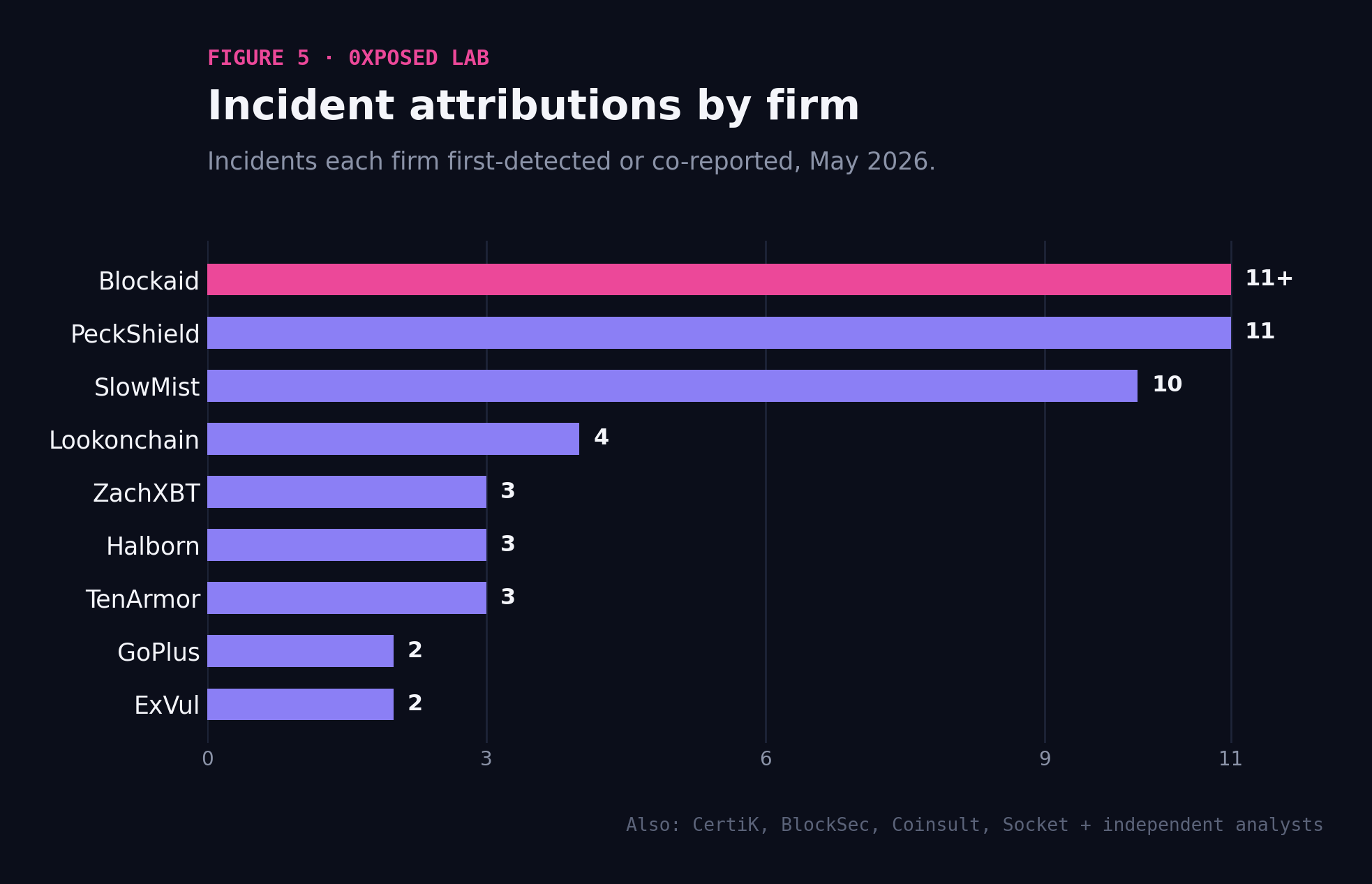
Three names do most of the work. Blockaid has become the de-facto real-time alerting pipeline for Ethereum-family DeFi, flagging exploits as they unfold; PeckShield and SlowMist follow closely, and SlowMist's public hacked database remains the most complete archive of the smaller incidents nobody else bothers to log. Everyone after them — Lookonchain on fund-flow tracing, then ZachXBT, Halborn, TenArmor, GoPlus and ExVul — fills the gaps. It is a remarkably thin layer of specialists holding up incident visibility for the entire market, which is precisely why a single missed alert can leave an incident undocumented for days.
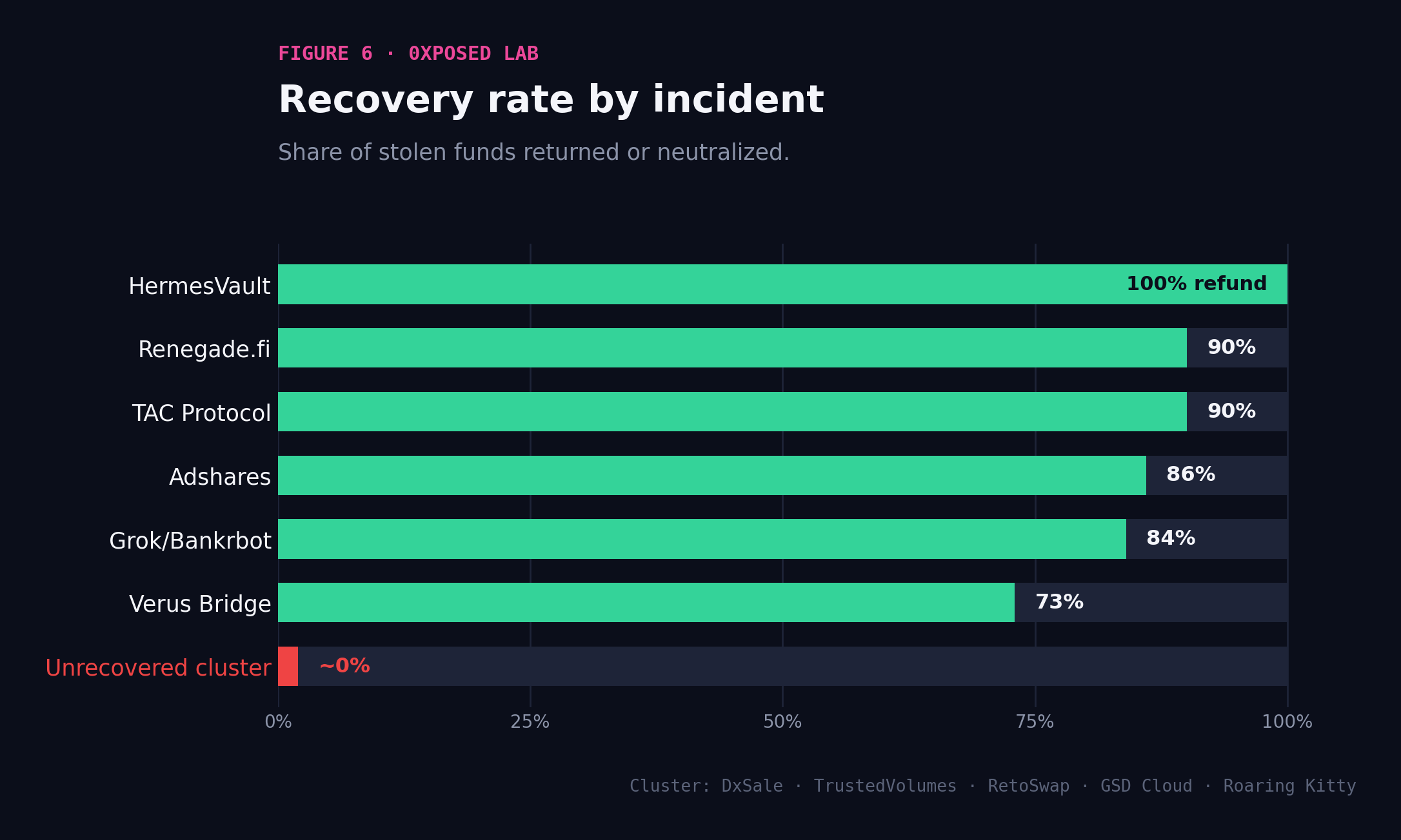
Recovery was sharply bimodal — and the deciding factor was the response pathway, not the size of the loss. Incidents caught live with an open negotiation channel (Verus, TAC, Adshares, Renegade.fi, Bankr) returned 73–90%. Incidents where attackers swapped to ETH and mixed immediately — or struck on a privacy chain like Monero — returned effectively nothing.
What to do about it
If you run a protocol with privileged keys: kill single-account admin authority on minting and bridge configuration. Require at least 2-of-N multisig with a 12-hour timelock between a config change and its effect. And deprecate legacy contracts properly — "no longer used" is not a security state.
If you operate cross-chain: never deploy with a 1/1 DVN; validate that source and destination amounts match on every message; audit abi.encodePacked with dynamic fields.
If you build AI-agent or auto-wallet systems: decouple natural-language output from financial actions absolutely. Enforce transfer caps, source whitelists and human confirmation on anything that moves value.
If you're a developer: pin your lockfiles, audit any dependency added between 19–25 May, and treat Rust
build.rsscripts and .cursorrules /CLAUDE.mdfiles as executable, untrusted code.If you're a user: never click sponsored Google results for crypto platforms — bookmark the real URLs — and revoke unused token approvals weekly.
A few caveats
Reported totals vary by source: $81.7M (Phemex/PeckShield) to $84.2M (Cryip). We use the conservative figure.
Kelp DAO's $292M is excluded from May statistics — its on-chain event was 18 April; only the post-mortem fell in May.
Superfortune is charted at its $5.7M realized figure, not the $15.18M nominal mint.
A few sub-$1M incidents (Sharwa.Finance, SmartCredit) have no published post-mortem and are flagged as unconfirmed.
No May incident carries high-confidence DPRK attribution at the time of writing.
All on-chain claims are independently verifiable on the respective block explorers. This report is informational and not financial, legal, or security advice.
0xposed Lab — Track. Document. Fight Back.